Agentry is a sandbox platform for managed agents by Hartie Labs: every call starts a user-specific agent sandbox in its own isolated container — preconfigured through profiles (verticals such as AI-SEO, support, data analysis, or PDF extraction). One generic image, any number of use-cases, with a live event stream, deterministic gates, and machine-readable artifacts.
Agentry
A sandbox platform for managed agents: every call starts a user-specific agent sandbox in its own container, preconfigured through profiles. One generic image, any number of verticals — formerly »KI-SEO«, now generic.
How it works
Verticals (profiles)
A profile = config (model/tools) + workspace (persona, conventions, skills). A new vertical is just a new folder — the platform shell stays the same.
Inside the platform
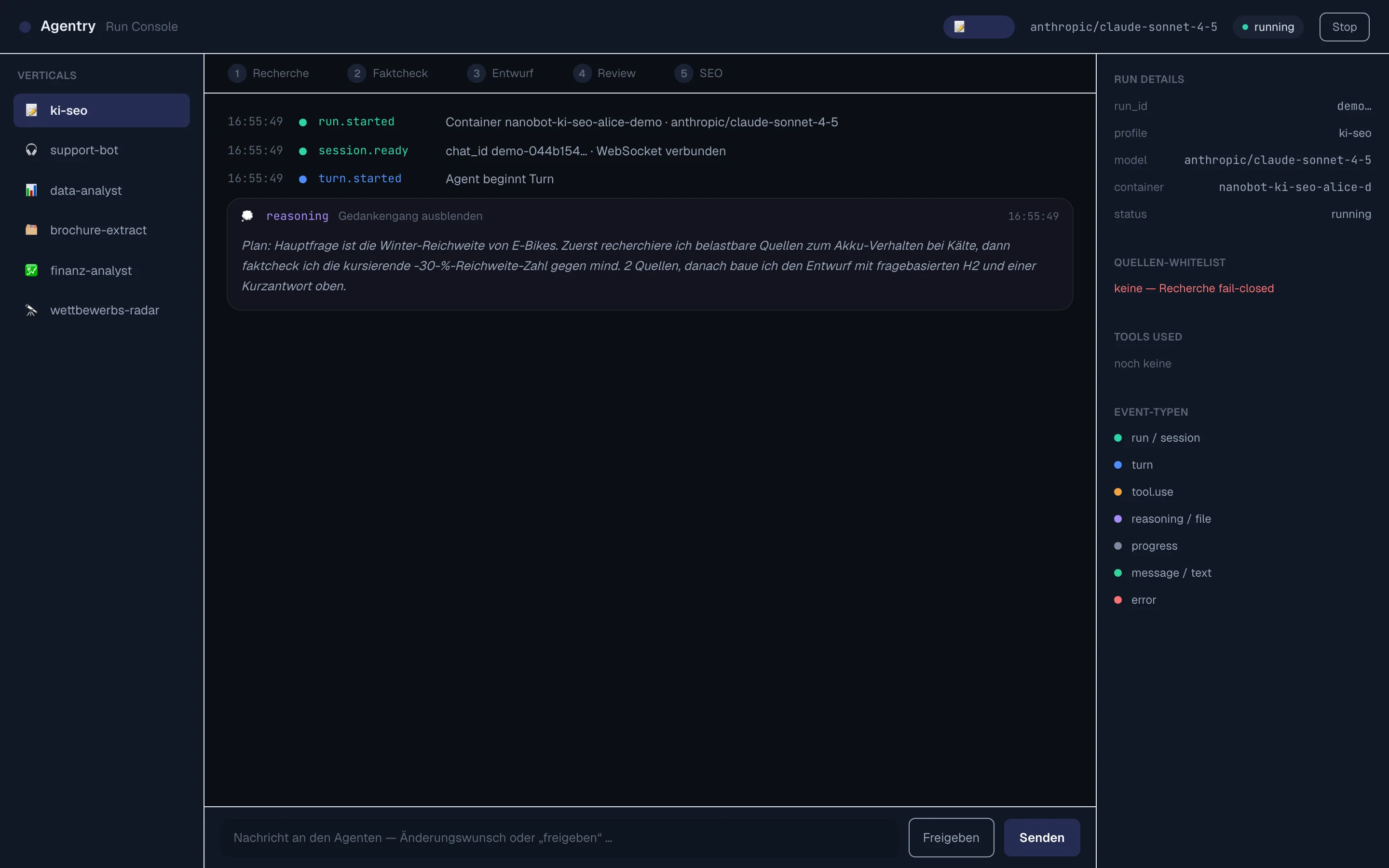
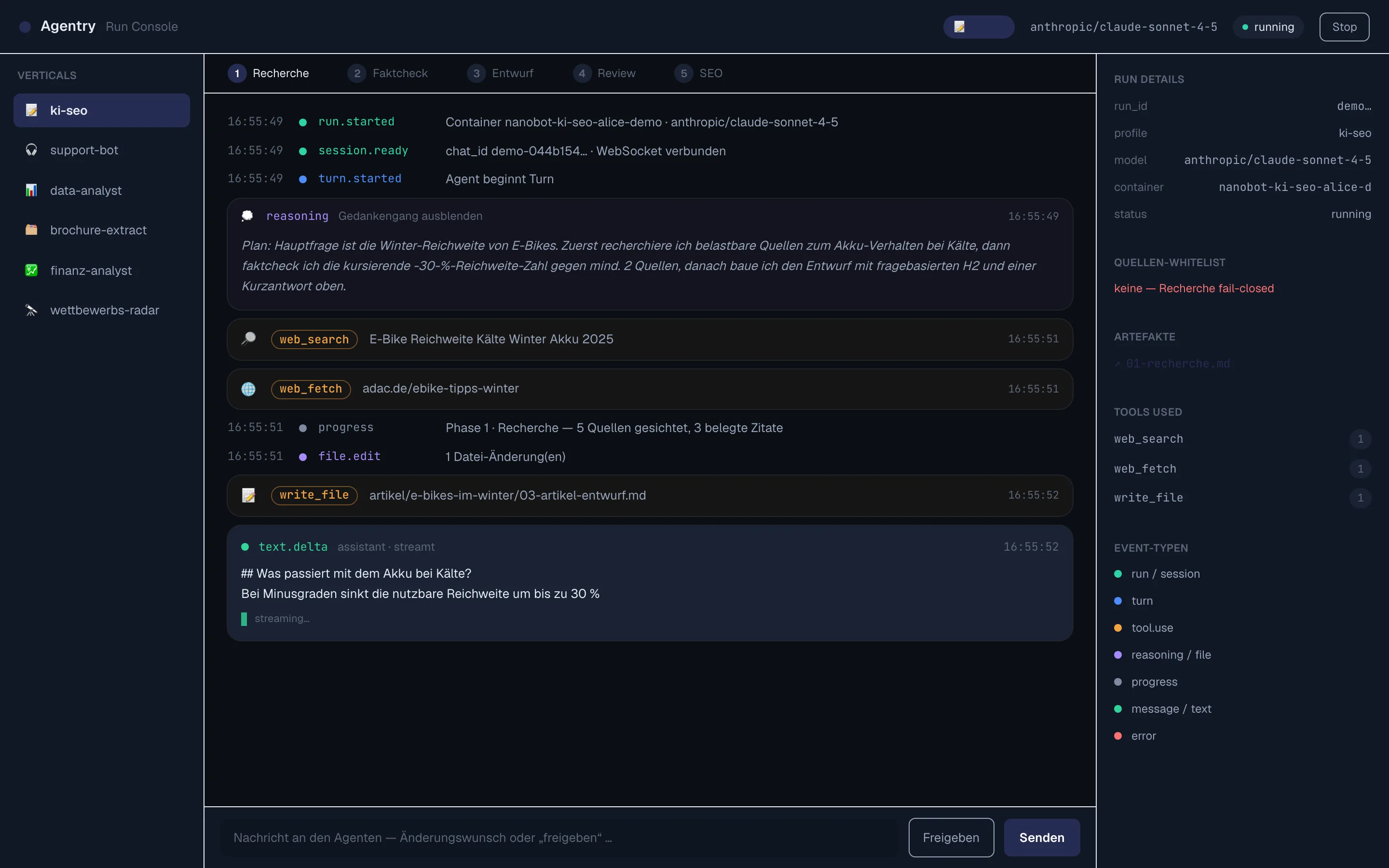
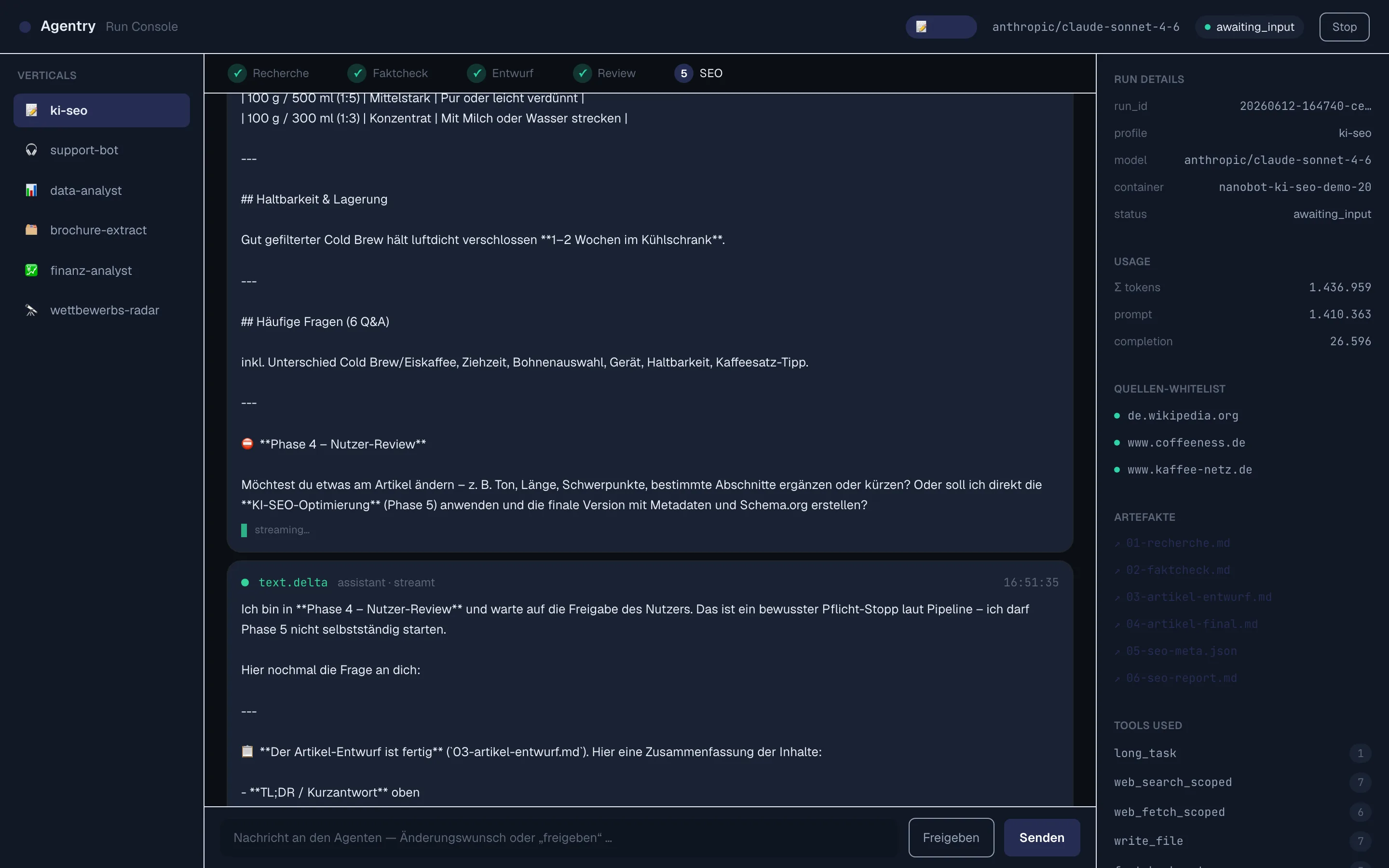
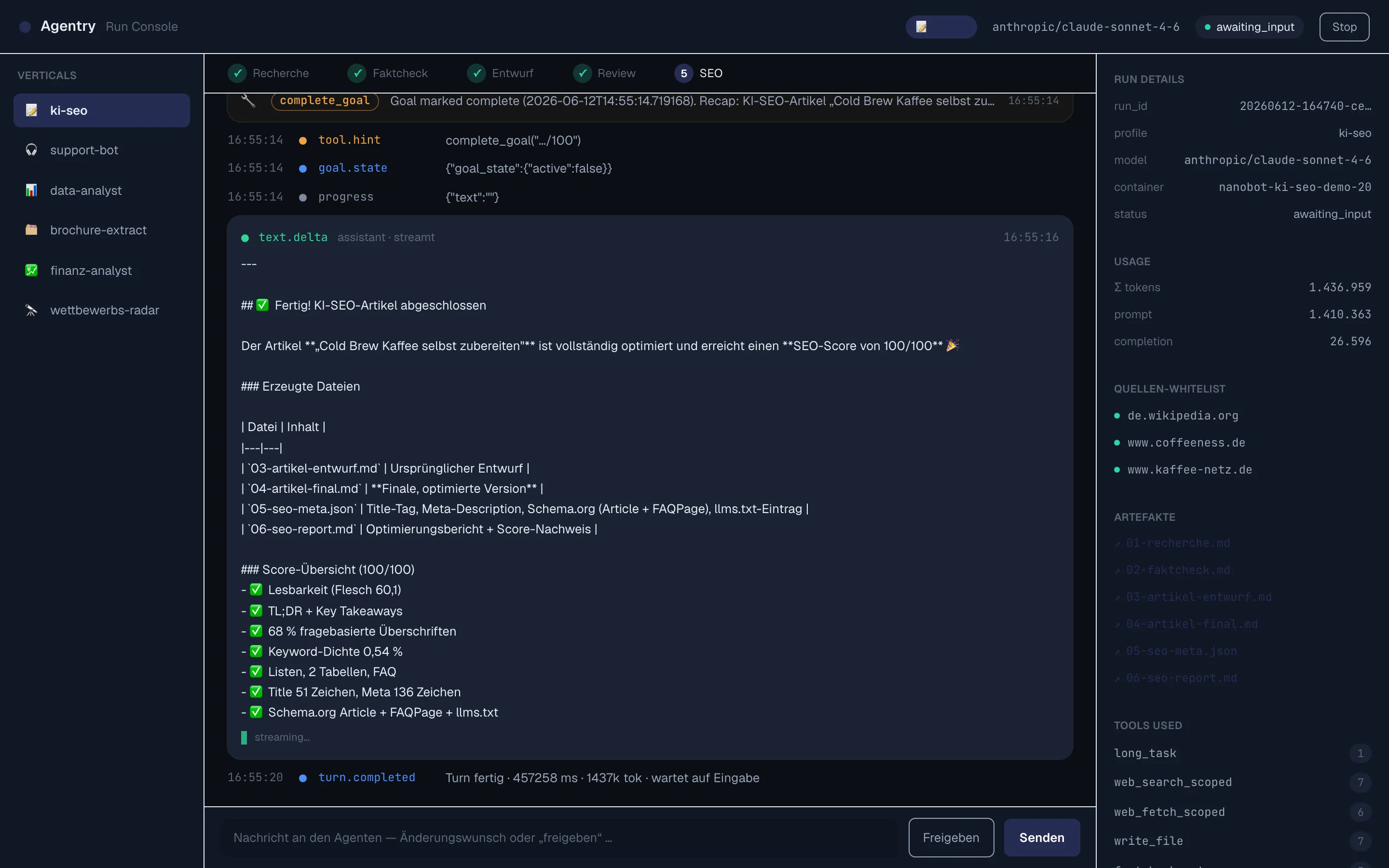
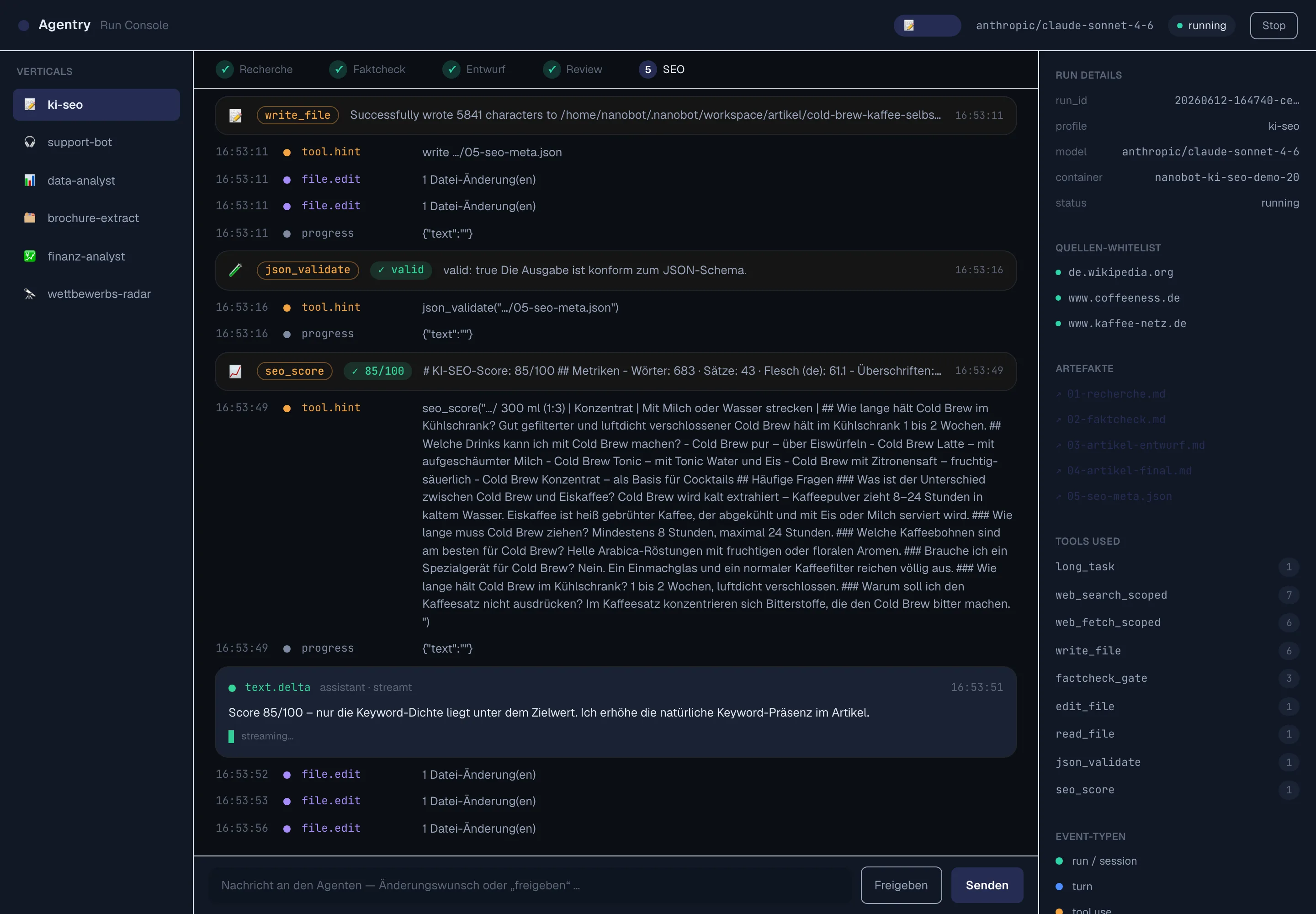
The same run console serves every profile: an event timeline on the left (live over SSE), observability side panels on the right. Click any shot to zoom.
Deep dive: the ki-seo use-case
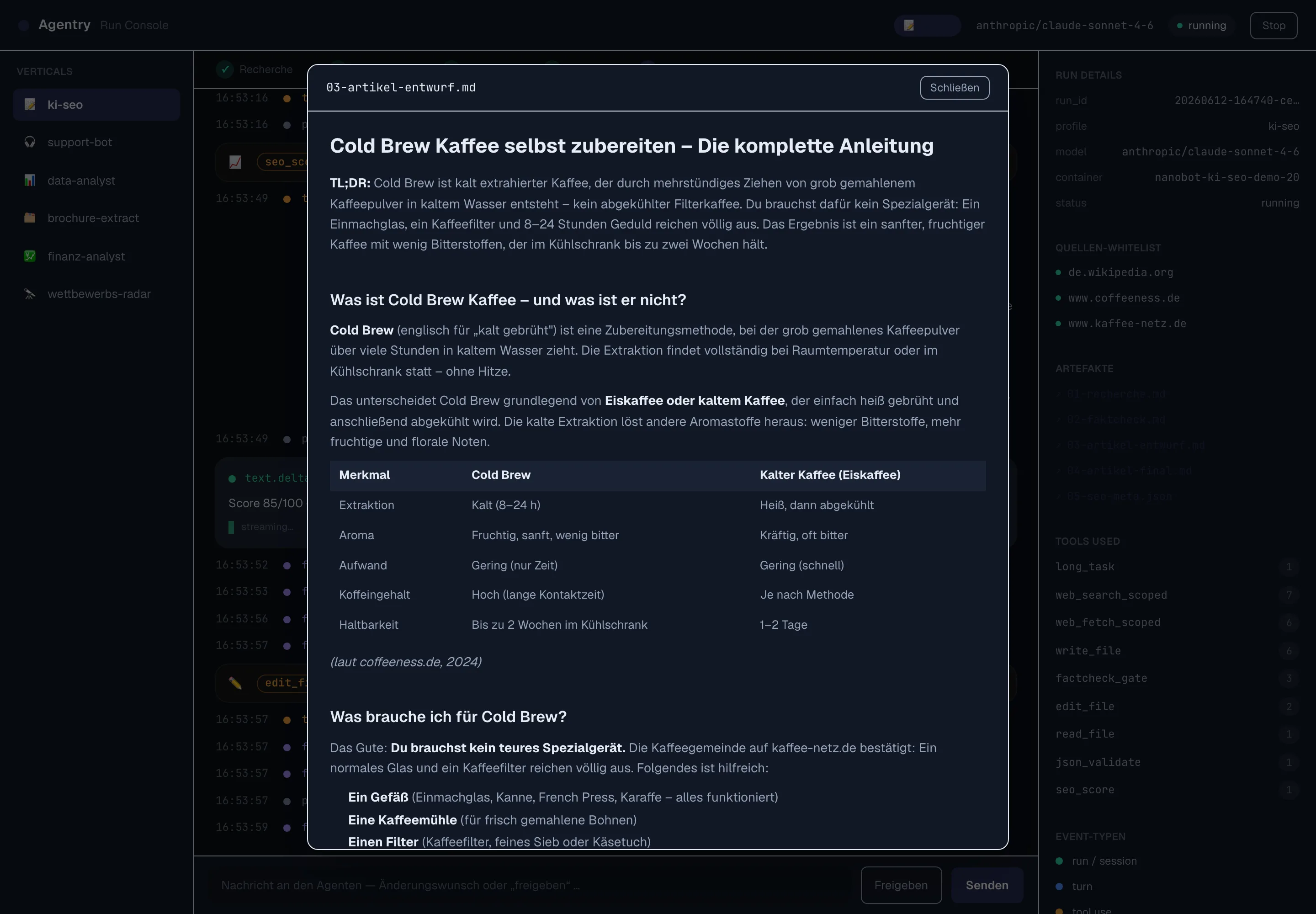
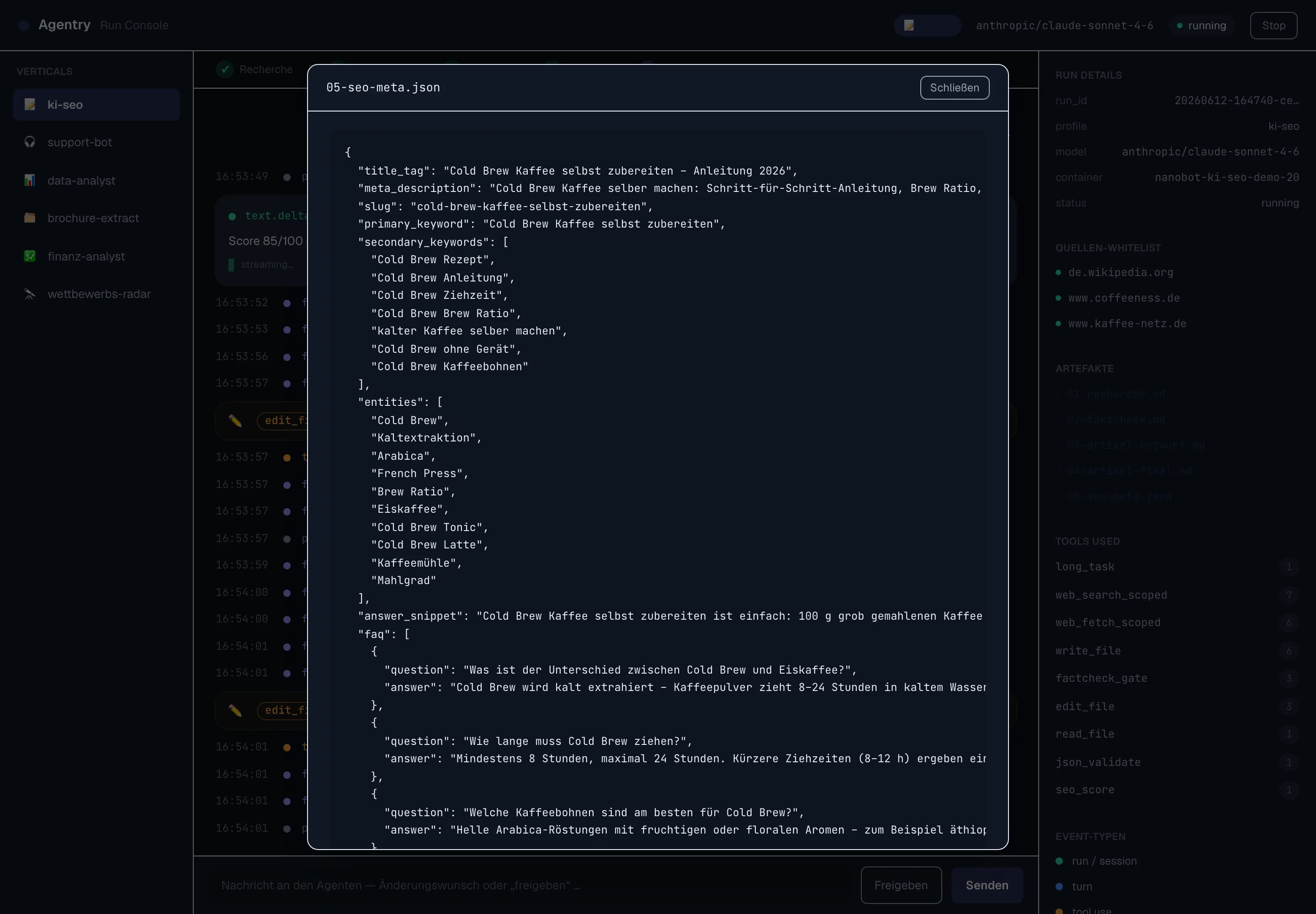
A full 5-phase run (research → fact-check → draft → user review → SEO) with its deterministic gates and machine-readable artifacts.
Demo: user app ↔ backend
Three use-cases, paired: left the user sees only the result, right a full isolated agent run streams in the backend.
Chat → custom tool
The user just writes an email; the agent calls a self-defined, declarative HTTP tool (no code, no own server) — egress only to the approved helpdesk domain.
PDF extraction
PDF + schema in, validated JSON out. The json_validate gate blocks anything not schema-conformant — garbage-in doesn't become garbage-in-the-DB.
Article (5 phases)
Source-restricted research (allowed domains only), fact-checked at a gate, written in 5 phases — it pauses at phase 4 for human approval, like in production.
Architecture & safety
The path of a run: the app calls the control plane via the SDK (the key stays server-side). It checks auth + budget, starts a fresh sandbox container per run, injects only approved tools/secrets, and streams normalized events live into the app and into a durable Postgres log — crash-safe and fully replayable.
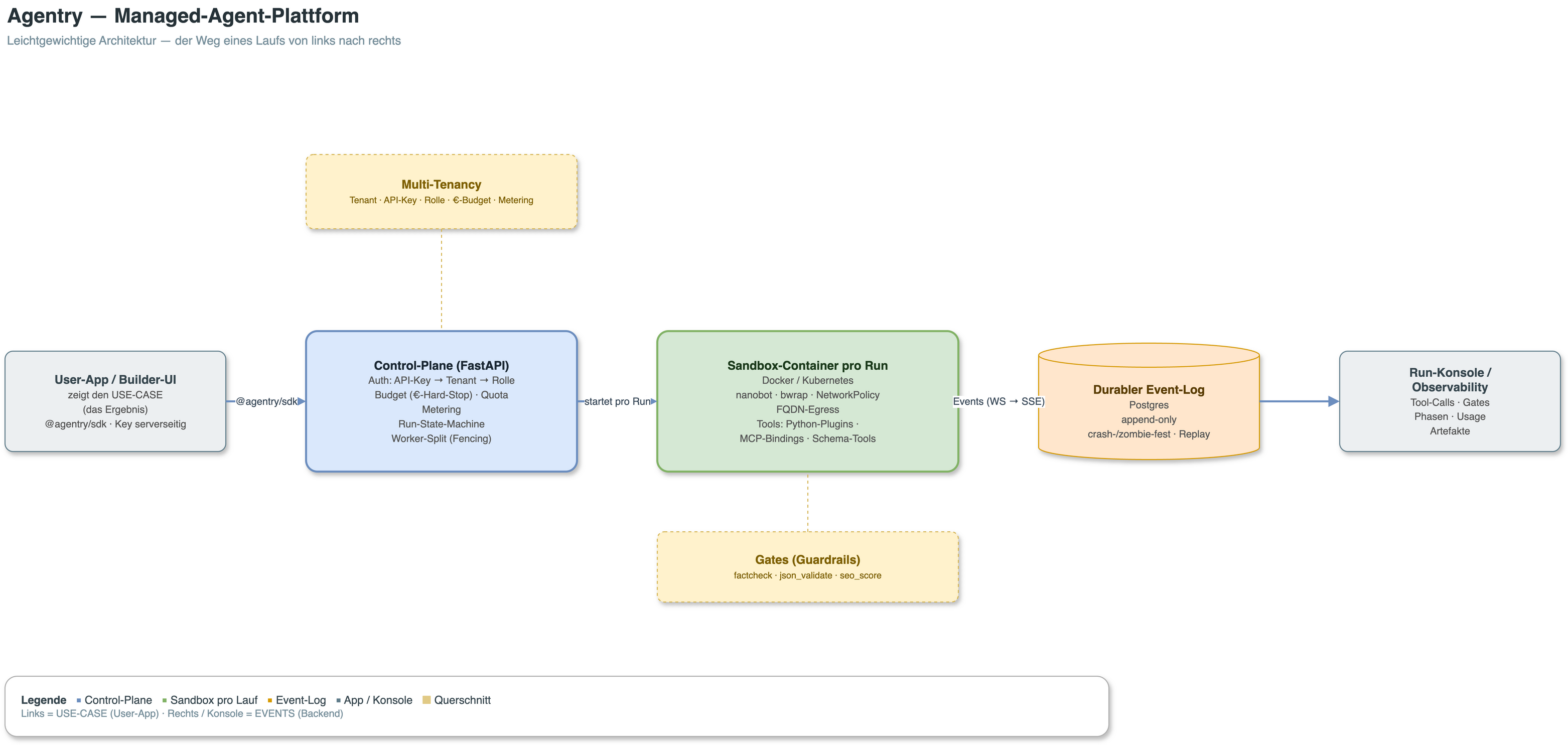
Two isolation layers: container per run + bubblewrap for the agent's shell; --cap-drop ALL, memory/CPU/PID limits.
Provider API keys and tenant secrets are passed only as container env (AES-GCM at rest), never written to disk.
Deterministic gates around the non-deterministic LLM: factcheck_gate, json_validate, seo_score — reproducible pass/fail.
Fork-to-build: every catalog agent can be forked copy-on-write; the in-app Architect drafts SOUL/skills, nothing ships without a click.
€-metering from real provider tokens; budget overrun rejects new runs with 402 before a sandbox even starts.
Durable Postgres event log + run state machine; a typed TypeScript SDK embeds the agents into other apps with the key kept server-side.
Frequently Asked Questions
What is Agentry?
A managed-agent platform that starts an isolated nanobot sandbox in its own container per call. Use-cases are preconfigured via profiles — one generic image serves any number of verticals. The platform was formerly called »KI-SEO«; AI-SEO is now just one of the profiles.
How is each run isolated?
Two layers: outside, an ephemeral Docker container (or k8s pod) per call with --cap-drop ALL and memory/CPU/PID limits; inside, a bubblewrap sandbox for the agent's shell. The per-user workspace persists; the container is thrown away.
What are profiles and gates?
A profile bundles model, tools, persona, and skills for a vertical. Gates are deterministic code around the non-deterministic LLM — e.g. factcheck_gate (≥2 independent sources per claim), json_validate (JSON schema), and seo_score. They produce reproducible pass/fail results before publishing.
How is the platform controlled?
Through a FastAPI control plane that launches a container per call and streams normalized agent events as SSE. A Next.js web UI shows the live stream per run; a typed TypeScript SDK (@agentry/sdk) embeds the agents into other apps — the provider key stays server-side.